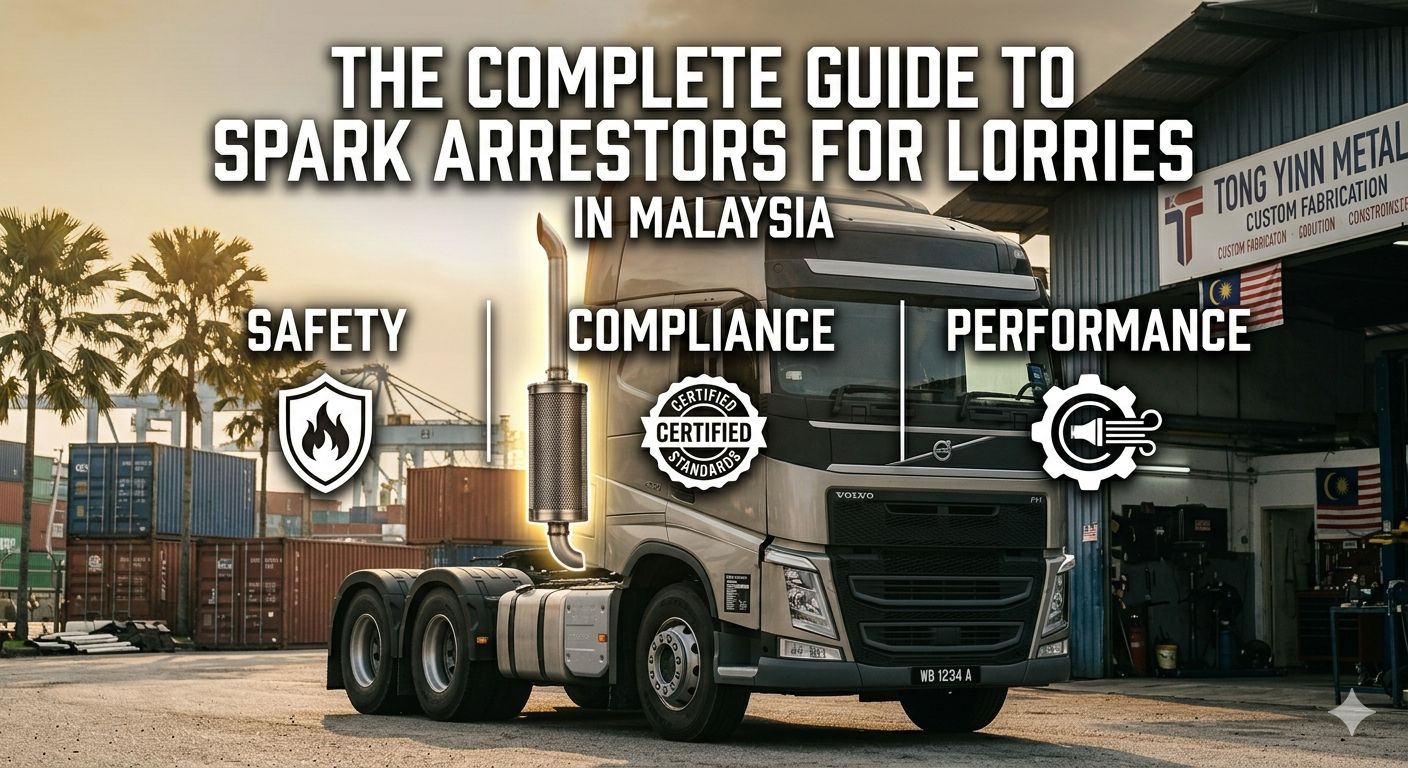
In the world of logistics and industrial transport, safety isn’t just a buzzword—it’s a license to operate. For fleet managers, independent abang lorry, and Health, Safety, and Environment (HSE) officers (the Who), a spark arrestor for lorry (the What) is a critical safety component fitted to the exhaust system of a diesel engine. Its primary job is to trap and extinguish incandescent carbon particles (sparks) before they can exit the tailpipe.
But Why is this so important? In Malaysia, many lorries operate in “Zone 1” or “Zone 2” high-risk areas, such as oil refineries, chemical plants, and timber yards. Without a certified exhaust spark arrestor, a single stray spark could ignite flammable vapors or dry materials, leading to catastrophic explosions or fires. Whether you are transporting dangerous goods or simply entering a Petronas terminal, having a high-quality spark arrestor for truck applications is the difference between a successful delivery and a total site ban—or worse, a preventable disaster.
Key Takeaways
- Primary Purpose: Spark arrestors prevent fire hazards by trapping hot carbon deposits from diesel exhaust.
- Mandatory Compliance: Most Malaysian oil and gas terminals and chemical plants will refuse entry to any lorry or truck not equipped with a certified arrestor.
- Maintenance is Key: Soot buildup can restrict airflow, leading to engine overheating; regular cleaning is essential for performance.
- Material Choice: Stainless steel options are preferred in Malaysia’s humid climate to prevent corrosion and structural failure.
- Ease of Use: “Slip-on” portable units allow for flexibility, while permanent installations are better for dedicated DG (Dangerous Goods) vehicles.
What is a Spark Arrestor for a Lorry?
Technically speaking, a spark arrestor for lorry is a mechanical device designed to remove flammable particles from the exhaust stream of an internal combustion engine. Unlike a muffler, which focuses on sound dampening, the arrestor focuses on fire prevention.
In diesel engines, incomplete combustion often results in the formation of carbon soot. These carbon deposits can become “incandescent”—meaning they glow red-hot. If these sparks are ejected from the exhaust pipe into an environment filled with flammable gases or dry vegetation, the result is an immediate fire risk.
How an Exhaust Spark Arrestor Actually Works
Most modern exhaust spark arrestor units used in Malaysia utilize a centrifugal or “cyclonic” design.
- Vortex Creation: As the exhaust gases enter the arrestor, internal stationary vanes force the gas into a high-speed swirling motion.
- Centrifugal Force: Because carbon sparks are heavier than the exhaust gas, they are flung outward toward the walls of the arrestor.
- Trapping: The sparks are then collected in a specialized “soot trap” or carbon well, where they cool down and lose their heat safely, while the clean exhaust gas exits through the center of the unit.
For those looking for high-quality fabrication of these units, you can find more details at [Spark Arrestors Malaysia | Exhaust Spark Arrestor Manufacturer & Supplier].
Why You Need a Spark Arrestor in Malaysia
Malaysia is a global hub for the oil, gas, and petrochemical industries. From the refineries in Kerteh and Pengerang to the busy ports of Klang and Bintulu, safety protocols are incredibly strict.
The “Who”: Industries and Personnel Involved
The demand for a spark arrestor for truck usage comes from several sectors:
- Logistics Companies: Hauling fuel, chemicals, or flammable liquids.
- Construction Firms: Working in proximity to gas pipelines or refineries.
- Agriculture: Especially lorries entering palm oil mills or timber yards where dry chaff and wood dust are highly combustible.
- HSE Managers: Responsible for ensuring every vehicle on-site meets SIRIM or international safety standards.
The “Why”: Preventing Industrial Catastrophes
In a tropical climate like ours, heat management is already a challenge. A diesel engine under heavy load—climbing a steep grade or hauling a full trailer—will naturally produce more carbon sparks. If that lorry enters a loading bay at a chemical plant, the environment may contain “fugitive emissions” (unintentional gas leaks). Without an arrestor, the truck becomes a giant ignition source.
Compliance isn’t just about safety; it’s about business continuity. If your vehicle fails an inspection at a terminal gate because of a faulty or missing spark arrestor for lorry, you lose time, money, and reputation.
Types of Spark Arrestors for Trucks and Heavy Vehicles
Depending on your operational needs, you can choose between different configurations of the device.
Permanent vs. Portable (Slip-on) Units
- Permanent Spark Arrestors: These are welded or bolted directly into the exhaust system, often replacing the standard tailpipe or integrated with the muffler. These are ideal for dedicated fuel tankers that spend 100% of their time in high-risk zones.
- Portable/Slip-on Spark Arrestors: These are popular among general haulage lorries that only occasionally enter refineries. They can be clamped onto the existing tailpipe before entering a site and removed afterward. They are versatile but require a secure fit to prevent exhaust leaks.
Material Matters: Carbon Steel vs. Stainless Steel
In Malaysia, the choice of material is vital.
- Carbon Steel: Cheaper initially, but susceptible to the high humidity and heavy rain of our climate. They tend to rust from the inside out due to the acidic nature of exhaust condensate.
- Stainless Steel (304 or 316 Grade): Highly recommended. These units resist corrosion, handle higher thermal stress, and generally last the lifetime of the truck.
To explore material options tailored for the Malaysian market, visit [Spark Arrestors Malaysia | Exhaust Spark Arrestor Manufacturer & Supplier].
Compliance and Safety Regulations in Malaysia
Operating a lorry in Malaysia without the correct safety equipment can lead to heavy fines from the Department of Environment (DOE) or the Road Transport Department (JPJ), especially if you are involved in Dangerous Goods (DG) transport.
Oil & Gas Requirements (Petronas, Shell, BHP)
Major oil companies in Malaysia follow the OGP (Oil and Gas Producers) standards. Every vehicle entering their terminals must have an exhaust spark arrestor that is:
- Certified to international standards (like the USDA Forest Service Standard 5100-1 or European EN standards).
- Properly sized for the engine’s Kilowatt (kW) output to ensure backpressure does not damage the engine.
Chemical and Dangerous Goods (DG) Transportation
Under the APAD (Land Public Transport Agency) and JPJ guidelines for DG vehicles, fire suppression and prevention are mandatory. A spark arrestor for lorry is often part of the required safety kit, alongside fire extinguishers and master “kill switches” for the electrical system.
Installation and Maintenance Best Practices
A spark arrestor is not a “fit and forget” device. Because it is designed to trap carbon, it will eventually get dirty.
Cleaning and Carbon Build-up
Over time, the soot trap fills up. If it isn’t cleaned, two things happen:
- Fire Risk Increases: Ironically, a clogged arrestor can hold so much hot carbon that it eventually starts spitting out chunks of hot soot.
- Engine Damage: A clogged arrestor creates “backpressure.” This makes the engine work harder, increases fuel consumption, and can lead to turbocharger failure or engine overheating—a common sight on Malaysian highways.
Maintenance Tip: Most units have a “clean-out plug.” This should be opened every 5,000 to 10,000 km (or more frequently if the lorry does heavy idling) to flush out accumulated carbon.
Choosing the Right Spark Arrestor Manufacturer
When sourcing a spark arrestor for lorry, you shouldn’t just look for the lowest price. A poorly designed arrestor can choke your engine or, worse, fail to stop a spark.
Look for a manufacturer that provides:
- Flow Calculations: They should ensure the arrestor matches your engine’s CFM (Cubic Feet per Minute) exhaust flow.
- Certification: Documentation that the unit meets industrial safety standards.
- Local Support: A supplier who understands the specific terminal requirements in Malaysia.
For a reliable partner in the region, check out [Spark Arrestors Malaysia | Exhaust Spark Arrestor Manufacturer & Supplier].
Frequently Asked Questions (FAQ)
- Does a spark arrestor reduce my lorry’s engine power? If properly sized, the reduction in power is negligible (less than 1%). However, if you use a unit that is too small for your engine’s displacement, or if you fail to clean it, the resulting backpressure will significantly reduce horsepower and fuel efficiency.
- Can I use a spark arrestor instead of a muffler? While some spark arrestors have noise-dampening properties, they are not a direct replacement for a muffler. In most Malaysian lorries, the arrestor is installed in addition to the existing exhaust system.
- Is it a legal requirement for all lorries in Malaysia to have one? No, it is not required for all lorries. It is specifically required for vehicles transporting flammable or dangerous goods, and any vehicle (regardless of cargo) entering high-risk industrial sites like refineries, timber yards, or certain construction zones.
- How do I know if my spark arrestor is still working? Check for structural integrity. If there are holes in the body or the internal vanes have rusted away, the centrifugal action will fail, and sparks will pass through. You should also listen for rattling, which indicates internal components have broken loose.
- How often should I clean the soot trap? For lorries used in heavy-duty cycles or those that spend a lot of time idling (like fuel tankers at delivery points), we recommend checking and cleaning the trap once a month or every 5,000km. A quick visual check of the exhaust smoke can also tell you if the system is becoming restricted.